
Can a Dreo Radiator Heater Warm a Large Room?

Most people assume a heavy oil radiator will blast quick heat across a huge, open living area. In reality, a plug-in radiator is not built to warm drafty open spaces, because standard wall plugs limit how much heat any portable unit can produce. Instead, this style of heater is ideal for steady, silent warmth in a closed room where the heat cannot escape.
How well one works in your home comes down to your floor plan and your patience. A closed bedroom with regular ceilings traps the rising warmth naturally, while tall ceilings and open hallways let the warm air drift away before you feel it. Drafty windows can also pull heat out faster than the unit warms the air, and oil takes about half an hour to get truly hot. Here is how to tell if this heating style matches your space before you plug one in.
A 1500-watt radiator cannot warm giant drafty spaces
Every standard portable electric heater sold for home use in the United States runs into a hard physical ceiling: 1,500 watts. That wattage equals roughly 12.5 amps on a standard 120-volt household circuit. Because your wall outlet cannot safely deliver more continuous power than that without tripping a breaker or melting wires, no plug-in radiator produces more raw heat than any other standard space heater.
Heating engineers use a dependable rule of thumb for residential living spaces: you need roughly 10 watts of heating power for every square foot of floor space. That means a 1,500-watt heater is designed to raise the temperature in a closed room of about 150 square feet all on its own. When used in a larger room, up to roughly 300 square feet, an oil radiator works effectively as supplemental heat, lifting the room temperature by several degrees while your home furnace provides the baseline background warmth.
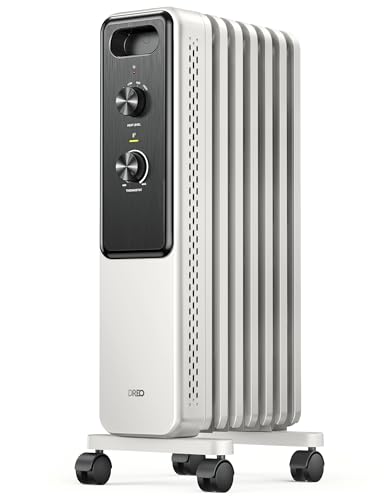
A Dreo radiator heater uses 1500W full power heating with specialized M-shaped fins to push thermal energy into the air. In models with 7 fins, the layout provides 39.5 percent more heating surface area than traditional flat fins. In larger 8-fin designs, the dissipation area increases by 59.5 percent. Even with that extra surface area, the heater cannot perform miracles in a massive, open-concept living room. If your room flows directly into an open kitchen, has an open stairwell, or features 12-foot cathedral ceilings, the heat spreads thin across that enormous volume of air.
Heating speed also catches many people off guard. An oil-filled radiator is a sealed metal heater that releases gentle heat without blowing air. It contains a specialized heat-retaining fluid that an internal electrical element must warm up first. It usually takes 20 to 30 minutes for the oil to heat the outer metal fins and begin warming the room air. If you expect instant hot air the moment you turn it on, an oil radiator will leave you shivering during that initial warm-up period.
Radiators warm steady while fan heaters blast quick air
Understanding how an oil radiator warms a room explains why so many people prefer it over a noisy fan heater, even in larger spaces. Most portable heaters use a ceramic heating element that warms up in seconds, paired with a small electric fan that pushes warm air across the room. That design creates instant hot air in a narrow beam. But as soon as that fan turns off, the room air cools down quickly because the heat was never absorbed into the room itself.
A Dreo radiator relies on natural convection, which is the physical process of warm air rising to push cold air down naturally. As the electrical element warms the sealed oil inside the metal fins, the outer steel panels become hot. The air touching those fins heats up, expands, and rises quietly toward the ceiling. As that warm air floats upward, it pulls cooler air from the floor level into the bottom of the heater to take its place. This creates a gentle, continuous loop of circulating warmth without blowing any dust, pet dander, or dry air across the room.
At the same time, the hot steel body of the radiator produces radiant heat. That radiant energy warms solid objects directly, including your couch, rugs, wood flooring, and your own body. Those solid surfaces absorb the thermal energy and slowly release it back into the room. This thermal mass effect means that when the heater cycles off to save electricity, the room does not suddenly feel cold. The warmth lingers, creating a quiet, cozy environment that feels much more like central heating than a portable space heater.
Check your room layout before choosing an oil heater
Before bringing a Dreo radiator into your home, evaluate your space to confirm whether an oil radiator matches your room layout. An oil heater excels under specific room conditions and struggles in others.
- Closed interior doors: Radiator heat builds up through gentle circulation. If you can close the door to your bedroom, home office, or den, the radiator will easily warm a space up to 300 square feet. If the room opens into a hallway or adjoining rooms, the warm air escapes before the room reaches your set temperature.
- Standard ceiling heights: Convection naturally sends the warmest air straight to the top of the room. Rooms with standard 8-foot or 9-foot ceilings allow that warm layer to accumulate and push warmth back down into your living zone. Rooms with two-story ceilings or lofts will trap the warmth near the roofline where you cannot feel it.
- Window and wall insulation: Modern double-pane windows and insulated exterior walls hold heat inside efficiently. If your room has old, single-pane glass, unsealed exterior doors, or uninsulated walls, the room loses warmth faster than a 1500W heater can produce it. For drafty, unsealed living areas, looking into a dedicated heater for drafty enclosed spaces will deliver better results than a passive radiator.
- Expectations for supplemental warmth: If your room is 250 to 350 square feet, the Dreo radiator works best as an assist unit. It allows you to keep your central thermostat set at a cooler 64 degrees Fahrenheit while maintaining a comfortable 70 degrees in the specific room where you spend your evening.
Follow four setup steps for safe and even warmth
Getting the best heat distribution and maintaining total safety in a large room requires placing and operating the radiator correctly. Follow these practical steps when setting up the unit.
- Plug directly into a dedicated wall outlet. A 1500W space heater pulls 12.5 amps of continuous current. A standard household circuit in the United States is rated for 15 amps total. Never plug your radiator into an extension cord, power strip, or surge protector. Those intermediate cords cannot handle heavy, continuous electrical loads and can melt, scorch, or cause an electrical fire. Ensure no other high-draw appliances, such as an iron, microwave, or vacuum, share that same circuit breaker.
- Maintain the three-foot safety buffer. Position the heater so there is at least 3 feet (36 inches) of open clearance on all sides. Keep all bedding, curtains, throw blankets, upholstered chairs, paper, and pet beds well outside this boundary. While Dreo units feature fire-resistant materials and tilt protection, the exterior metal fins reach high temperatures that can overheat nearby fabrics.
- Position the unit near natural cold spots. Place the radiator along an exterior wall or just beneath a closed, drafty window rather than tucked into the back of the room. Setting the heater beneath the primary source of cold air catches chilly drafts before they spread across the floor. The falling cool air feeds directly into the base of the radiator, speeding up the natural convection cycle throughout the room.
- Set your target temperature on the digital display. When you first turn the heater on, select the highest heat setting so the oil and fins heat up quickly. Once the room reaches a pleasant temperature, use the digital temperature dial that clicks on and off to hold your set warmth. Setting the thermostat tells the internal sensors to monitor ambient air, cutting power when your target warmth is reached and cycling back on only when the room cools.
Avoid common mistakes that ruin room heating efficiency
Many homeowners assume their radiator is defective when poor heating is actually caused by simple placement mistakes. The most common error is tucking the radiator into an out-of-the-way corner or behind a piece of furniture to keep it hidden. Oil radiators require unrestricted open airflow around every single fin. If you push the heater against a sofa or between a desk and the wall, heat gets trapped around the unit. The automatic overheat sensor that shuts the unit off if internal parts get dangerously hot can trigger unnecessarily, or the thermostat will detect trapped heat and turn the unit off before the rest of the room ever gets warm.
Another frequent mistake is running an oil radiator in unconditioned or uninsulated utility spaces. Some people try to place a residential radiator in a cold workshop or detached outbuilding. Because concrete floors and uninsulated walls absorb heat instantly, a 1500W radiator will run continuously without making a dent in the chill. In those situations, you need a rugged heater for an uninsulated garage designed with high-volume airflow to fight severe cold.
Leaving interior doors open also wastes significant energy. An oil radiator works by slowly warming a specific volume of air. When the door remains open, that rising warm air drifts into hallways and up staircases, while cold air pours in along the floor. Keep the door closed to let the radiator establish a stable, comfortable thermal envelope.
Finally, avoid constantly adjusting the temperature settings. Turning the digital thermostat all the way up to its maximum limit does not make the heater warm up any faster. The heating element runs at full power whether the thermostat is set to 70 degrees or 85 degrees. Setting it too high simply causes the heater to run continuously, wasting electricity and making the room uncomfortably warm hours later.
What to look for in a large room radiator
When selecting a radiator heater to handle a large enclosed room, focus on design features that maximize surface area, improve safety, and automate temperature control.
Look for expanded fin geometry. Traditional radiators use flat, narrow metal fins that limit the amount of metal exposed to the air. Modern designs with widened, M-shaped, or curved fins dramatically increase the total dissipation area. That extra surface allows the heater to transfer thermal energy into the circulating air much faster, reducing the time it takes to balance room temperatures without requiring a noisy blower fan.
Prioritize precise electronic controls over basic manual dials. A digital thermostat with an automated eco mode continuously measures the ambient temperature in the room. Instead of running wide open all day, the unit automatically switches between high, medium, and low heat settings to maintain your desired temperature. This keeps power draw manageable and lowers your electric bill while keeping the room evenly warm.
Safety certifications are essential for any appliance that runs continuously in living areas or bedrooms. Verify that the heater carries a recognized safety mark, such as an ETL listing. Essential safety components include an automatic overheat sensor that shuts the unit off if internal parts get dangerously hot, a tip-over safety switch that cuts power instantly if the unit is knocked over or tilted, and a burn-proof plug designed to prevent overheating at the wall connection. Useful convenience features like a remote control, child lock, and a 24-hour timer allow you to customize operation without getting out of bed or worrying about curious pets.
Make sure the unit includes sturdy, smooth-rolling caster wheels and a solid carry handle. An oil radiator weighs between 17 and 22 pounds due to its steel housing and fluid reservoir. Having durable wheels lets you roll the heater smoothly from your home office during the day to your primary bedroom at night, giving you quiet, steady warmth right where you need it most.
- BWP Score9.5
BWP Score is a ranking system developed by Bestwinterproducts.com. BWP score has no relationship or impact from any manufacturers or sales agent websites. Learn more
- BrandDREO

- BWP Score9.4
BWP Score is a ranking system developed by Bestwinterproducts.com. BWP score has no relationship or impact from any manufacturers or sales agent websites. Learn more
- BrandDREO

- BWP Score9.4
BWP Score is a ranking system developed by Bestwinterproducts.com. BWP score has no relationship or impact from any manufacturers or sales agent websites. Learn more
- BrandDREO

- BWP Score8.3
BWP Score is a ranking system developed by Bestwinterproducts.com. BWP score has no relationship or impact from any manufacturers or sales agent websites. Learn more
- BrandDREO

- BWP Score8.0
BWP Score is a ranking system developed by Bestwinterproducts.com. BWP score has no relationship or impact from any manufacturers or sales agent websites. Learn more
- BrandDREO

- BWP Score7.7
BWP Score is a ranking system developed by Bestwinterproducts.com. BWP score has no relationship or impact from any manufacturers or sales agent websites. Learn more
- BrandDREO

- BWP Score7.6
BWP Score is a ranking system developed by Bestwinterproducts.com. BWP score has no relationship or impact from any manufacturers or sales agent websites. Learn more
- BrandDREO
Last update on 2026-10-12 / Affiliate links / Images, Product Titles, and Product Highlights from Amazon Product Advertising API
.jpg)

Best Warm Winter Scarves 2026 For Cozy Comfort

Best Green Ski Goggles 2026 For Clear Vision On Slopes

12 Best Corner Electric Fireplace 2026: My Ultimate Guide To Pick One

Best Battery Powered Snow Blower 2026 For Effortless Snow Clearing

Best Ski Goggles Under 30 Inches For Crisp Vision And Comfort

Best Cooling Scarf 2026 For Instant Relief And Comfort

Fake Snow for Grass: Create a Realistic Winter Lawn Display

Dimplex Prism Wall Mount Fireplace: Sleek Heat With Modern Flame Style





