
Can the Dreo Tower Fan Heater Combo Warm a Large Room?

Cold air creeps across the living room floor, prompting someone on the couch to pull a fleece blanket tighter while hoping a tall electric tower will warm the space. The reality is that a portable plug-in heater cannot heat a large room on its own. Wall outlets put a strict limit on electric heat, so no portable unit can match a central furnace in a large space. What a tall oscillating tower does well is provide focused warmth across a seating area so people nearby stay comfortable.
How warm the room feels depends on ceiling height, window drafts, and where the unit sits. Tall vaulted ceilings quickly pull rising heat away from the floor, while leaky window seals let cold air erase the gain. Trying to warm an entire open layout will only run up your electric bill, but aiming the airflow directly at your living space keeps you cozy. Here is how to use that heat effectively.
The 1500-Watt Wall Outlet Limit: Why Portable Units Cannot Warm a Large Room Alone
Every standard plug-in electric space heater sold in the United States shares the exact same power ceiling: 1500 watts. In American homes, a regular household wall outlet runs on a 120-volt electrical circuit. Because standard breakers are rated for 15 amps, electrical safety rules cap portable plug-in heating appliances at 1500 watts (drawing about 12.5 amps) to prevent wires inside your walls from melting or sparking. Converted to heat output, 1500 watts produces roughly 5,120 British Thermal Units (BTUs) of warmth per hour. That ceiling never changes, no matter what brand name is on the plastic shell, what motor turns inside, or what marketing claims appear on the box.
To understand what that limit means in daily life, consider the standard heating rule of thumb: an electric space heater requires roughly 10 watts of power for every single square foot of ordinary living space. In a closed 150-square-foot bedroom with standard eight-foot ceilings and shut doors, a 1500-watt unit easily warms the entire volume of air from wall to wall. It raises the room temperature steadily because the heat cannot escape, allowing the heater's built-in thermostat to cycle off periodically once the space reaches your target comfort level.
A large living room, great room, or open-concept floor plan completely changes that dynamic. When a room expands to 300, 400, or 600 square feet, heating the entire space requires anywhere from 3,000 to 6,000 watts of continuous thermal energy. A single 1500-watt wall appliance cannot produce that much warmth. High ceilings make the situation even harder. Because warm air naturally rises, the heat generated by a portable unit floats straight up toward the rafters, leaving the lower floor area where you sit uncomfortably cool.
Drafty exterior doors, single-pane windows, and open stairwells pull warmth out of the living area just as fast as a small heater adds it. Homeowners dealing with uninsulated spaces often run into this reality when searching for a heater for an enclosed porch or an unfinished addition. Expecting any 1500-watt tower to function as the primary heating system for a huge open room will only lead to disappointment. The heater will run continuously on its highest setting without ever shutting off, driving up your electric bill while the outer corners of the room stay cold.
Where a tall tower unit actually succeeds is through intentional zone heating. Zone heating means you leave your central furnace thermostat set to a lower, energy-saving temperature (such as 64 degrees Fahrenheit) and use a targeted portable heater to warm only the immediate area where your family gathers. Instead of trying to heat 500 square feet of empty air, you focus that 1500 watts directly onto your couch, reading chair, or desk.
Airflow and Coverage: How the Dreo Tower Circulates Warmth Differently
Most basic portable space heaters fail in large rooms because they rely on weak, noisy fans or simple radiant heat fins. A small box heater warms only a tight pocket of air directly in front of its plastic grille. Because that warm air lacks forward speed, it rises toward the ceiling almost immediately. You end up with toasty shins if you sit twelve inches away, but your shoulders stay chilly, and anyone sitting five feet to the side feels no warmth at all.
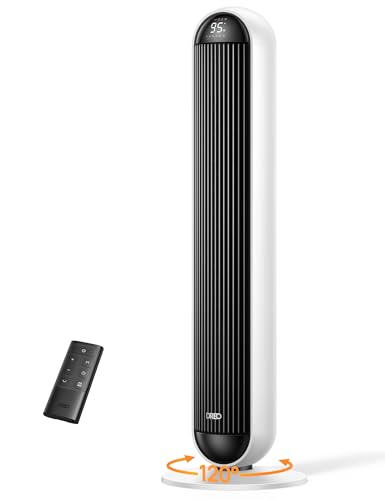
The Dreo MC706 addresses that circulation problem by borrowing the airflow design of a high-velocity cooling tower. Standing at 42.46 inches tall on a 12.91-inch base, this unit uses an upgraded 1800 RPM brushless DC motor to blow 1585 CFM of airflow volume (how much air the fan pushes per minute). That motor pushes warm air forward up to 40 feet across a room. Instead of allowing heat to drift straight upward, the high-velocity blower propels heated air across open floor space, mixing it with the room air before it escapes.
The heating core pairs that airflow with a ceramic heating element that warms up in seconds (a Hyperamics PTC ceramic block). Ceramic elements begin radiating noticeable heat almost instantly after turning the power dial, reaching full output in about two seconds. Combined with 120-degree ultrawide oscillation, the tower sweeps that warm air across a broad arc rather than firing a stationary jet at a single spot. If three people are seated across a wide sectional sofa, the sweeping airflow delivers a wave of warm air to everyone in that seating zone.
Height plays a major role in personal comfort. Compact heaters sit on the rug and blast hot air at your socks. Because this tower stands over 42 inches tall, its vertical air louvers discharge heat across the full height of your body when you are seated on a sofa or working at a desk. You feel the warmth across your legs, lap, and chest at the same time, which makes the surrounding room feel warmer much faster.
The seasonal versatility also solves a common household storage frustration. Traditional space heaters sit in a hallway closet gathering dust for eight months of the year. The Dreo MC706 features auto-shift technology that transitions from a 5-level 1500W winter heater into a 12-speed cooling fan for hot weather, offering 17 total operating levels across 6 modes. In summer fan mode, the heating element remains completely off while the DC motor runs down to a whisper-quiet 25 decibels, creating a gentle personal breeze. Keep in mind that a tower fan creates a cooling breeze across your skin through wind chill; it does not extract heat from the room like an air conditioner.
Where to Position a Tower Heater for Maximum Comfort
Placing a tower heater in the wrong spot in a large living room wastes energy and leaves you shivering. Setting up the unit correctly ensures the airflow reaches your body before drafts or high ceilings swallow the warmth. Follow these steps to position the tower for optimal comfort:
- Set the tower 8 to 12 feet away from your seating area. Because the motor pushes air up to 40 feet, placing the tower too close can make the breeze feel uncomfortably hot or dry on your skin. Placing it 8 to 12 feet away gives the warm stream room to spread out and gently envelop the entire couch.
- Direct the airflow along an interior path. Angle the oscillation arc across your central rug or along an interior wall rather than pointing the unit at an exterior window or glass patio door. Aiming heat directly at cold window glass speeds up heat loss through the pane.
- Maintain the 3-foot safety buffer. Keep a clear perimeter of at least 3 feet (36 inches) around the heater at all times. Keep throw blankets, curtains, dog beds, and upholstered furniture outside this clear zone to prevent fire risks and allow unobstructed air intake.
- Place the base firmly on a hard, flat surface. The 13.46-pound unit relies on an internal tip-over safety switch that cuts power instantly if the unit is knocked over or tilted. Thick, plush carpets can cause the tall tower to wobble or press unevenly against the switch, which may cause the heater to shut off unexpectedly.
- Use ceiling fans in reverse on low speed. If your large living room has tall or vaulted ceilings, flip your ceiling fan switch to clockwise (reverse) and run it on the lowest speed. This pulls cool air upward and pushes pooled warm air back down the walls into your seating space.
Electrical Safety and Running Costs on a Standard Circuit
Drawing 1500 watts of continuous electrical power places heavy demands on standard residential wiring. A standard 15-amp home circuit breaker is rated to handle up to 1,800 total watts, but national electrical safety guidelines suggest limiting continuous electrical loads (appliances running for three hours or more) to 80 percent of that total, which equals 1,440 watts. Running a 1500-watt space heater on high pushes right against that safe continuous threshold.
Similar to running an electric heater for a garage with a thermostat, you must understand what else shares the electrical circuit. If your living room outlets share a single breaker with a television, a gaming computer, floor lamps, or nearby kitchen outlets, turning on a coffee maker or microwave will instantly trip the circuit breaker. Managing electrical safety requires following clear, non-negotiable household rules.
- Plug directly into a dedicated wall receptacle: Never plug a high-draw space heater into a power strip, surge protector, or standard household extension cord. Power strips are not designed to carry a continuous 12.5-amp load and can melt, smoke, or catch fire behind furniture.
- Check the plug and faceplate temperature: After the heater has run on high for thirty minutes, touch the wall plug and the plastic outlet plate. A gentle warmth is normal, but if the plug or outlet feels hot to the touch or smells like warm plastic, turn the unit off, unplug it, and call a licensed electrician to inspect the receptacle for loose wire connections.
- Verify the safety shutoff features: Make sure the unit includes an automatic overheat sensor that shuts the unit off if internal parts get dangerously hot. Keep the rear air filter clean so dust does not choke off internal airflow.
- Turn the heater off when leaving the room: Space heaters are designed for attended supplemental warmth. Never leave a portable heater running in an empty living room or while your family sleeps overnight.
Operating costs also require realistic expectations. Running a 1500-watt appliance consumes exactly 1.5 kilowatt-hours (kWh) of electricity for every hour it operates on high. If your local utility company charges 16 cents per kilowatt-hour, running the tower for eight hours each evening adds roughly $1.92 per day to your power bill, or about $58 per month. To keep utility bills manageable, use the digital temperature controls and built-in timers. Set the unit to cycle down automatically once the immediate seating zone feels comfortable, rather than leaving it blasting on maximum power all evening.
What to Look for in an All-Season Tower Heater
When selecting a hybrid tower fan and heater for a spacious room, prioritize physical design features that promote airflow movement and household safety. Standard compact heaters rely on passive warmth, but a large living room requires a tall, fan-driven appliance capable of projecting heated air across an open floor plan.
Look for a model with a vertical height of at least 36 to 42 inches. Taller towers provide elongated air discharge vents that distribute warmth across seated body height, warming you from head to toe. Wide oscillation is equally vital: seek out units with an oscillation sweep of 90 to 120 degrees so the warm air reaches multiple furniture positions rather than baking a single spot.
Check the internal fan mechanics. Units equipped with modern brushless DC motors operate with noticeably less mechanical noise while maintaining high airflow volume. Look for multiple fan speeds on the cooling side and adjustable heat levels on the winter side, paired with a digital thermostat that cycles power automatically to maintain consistent comfort.
Finally, examine the built-in safety features before bringing any heater into your home. Confirm that the appliance carries recognized American safety certification marks, such as UL or ETL listings, on the manufacturer label. Essential protections include an internal tip-over switch that cuts power instantly if bumped by children or pets, an automatic overheat sensor that prevents internal thermal buildup, and a heavy-duty power plug designed to resist overheating at the wall connection.

- BWP Score9.4
BWP Score is a ranking system developed by Bestwinterproducts.com. BWP score has no relationship or impact from any manufacturers or sales agent websites. Learn more
- BrandDREO
- BWP Score8.7
BWP Score is a ranking system developed by Bestwinterproducts.com. BWP score has no relationship or impact from any manufacturers or sales agent websites. Learn more
- BrandDREO

- BWP Score7.7
BWP Score is a ranking system developed by Bestwinterproducts.com. BWP score has no relationship or impact from any manufacturers or sales agent websites. Learn more
- BrandDREO
- BWP Score7.4
BWP Score is a ranking system developed by Bestwinterproducts.com. BWP score has no relationship or impact from any manufacturers or sales agent websites. Learn more
- BrandDREO
Last update on 2026-10-12 / Affiliate links / Images, Product Titles, and Product Highlights from Amazon Product Advertising API
FAQs
Can you plug a 1500-watt tower heater into a heavy-duty extension cord?
No, you should always plug a 1500-watt space heater directly into a wall outlet. Portable electric heaters pull 12.5 amps of continuous current, which can cause extension cords and power strips to overheat, soften, and spark an electrical fire. If a wall outlet is not close enough to your desired seating area, rearrange your furniture rather than adding an extension cord.
Does the cooling fan mode lower the actual room temperature during summer?
No, the fan mode does not lower the temperature on a room thermometer. Tower fans cool your body through convective airflow, creating a wind-chill effect across your skin that evaporates moisture and helps you feel cooler. Unlike a window air conditioner, a fan does not remove heat or humidity from the indoor air.
What causes a tower heater to shut off on its own while running?
A tower heater usually shuts off automatically because its internal overheat sensor or tip-over switch was triggered. If dust blocks the rear intake grille or the unit sits too close to a wall, trapped heat builds up inside until the safety cutoff switches the unit off. To resolve this, turn the power off, unplug the cord, let the tower cool completely for thirty minutes, clean off any dust, and place the base on a firm, level floor away from furniture.


Best Warm Winter Scarves 2026 For Cozy Comfort

Best Green Ski Goggles 2026 For Clear Vision On Slopes

12 Best Corner Electric Fireplace 2026: My Ultimate Guide To Pick One

Best Battery Powered Snow Blower 2026 For Effortless Snow Clearing

Best Ski Goggles Under 30 Inches For Crisp Vision And Comfort

Best Cooling Scarf 2026 For Instant Relief And Comfort

Fake Snow for Grass: Create a Realistic Winter Lawn Display

Dimplex Prism Wall Mount Fireplace: Sleek Heat With Modern Flame Style





