
What Are the Different Sizes of Gas Heaters Available?

Gas heater sizes range by heat output. Units generally span from compact 10,000 BTU models for single bedrooms up to 125,000 BTU units for large workshops, with BTUs measuring how much heat they produce per hour. Physical cabinet dimensions grow alongside that power, shifting from slim two-foot wall panels to bulky three-foot ceiling boxes that blow warmth across an entire shop.
Finding the right match depends on your floor space, your ceiling height, and how well your walls hold heat. A drafty pole barn in freezing weather needs far more fuel than an insulated cabin with tight windows. Your choice also hinges on venting, since models requiring an outside exhaust pipe need extra clearance and dedicated hookups compared to vent-free panels. Here is how each size class works so you can pick the exact capacity for your space.
How Gas Heater Sizes Work: Heating Power Versus Cabinet Dimensions
When you start shopping for a gas heater, the word "size" actually means two different things. First, it refers to heating power, which manufacturers measure in British Thermal Units per hour (BTU). In simple terms, BTU measures how much heat a unit can produce every hour. Second, size refers to the physical cabinet dimensions, meaning the width, depth, and height of the metal box you hang on a wall, bolt to a ceiling, or set on the floor.
A gas heater with small physical dimensions can produce a surprising amount of warmth. A compact wall-mounted unit can easily heat a large bedroom, while a ceiling-hung furnace the size of a travel suitcase can warm a multi-car garage. Physical dimensions determine whether the unit fits safely in your room without blocking walkways, doors, or windows. Heating capacity determines whether your space actually stays warm when winter temperatures drop below freezing.
To pick the right unit, you have to look at both numbers together. If you only look at physical dimensions, you might buy a small wall heater that looks great but leaves your workshop freezing. On the other hand, if you only look at heating capacity, you might order a powerful furnace that is far too bulky to mount safely on your garage ceiling or that requires clearances your room cannot provide.
Standard Size Tiers: From Small Rooms to Large Workshops
Gas heaters generally fall into four standard size tiers based on heating capacity and physical footprint. Knowing these tiers makes it easy to narrow your search to units built for your specific square footage.
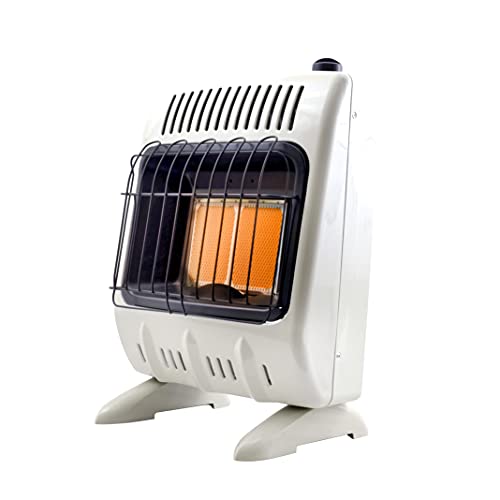
1. Small Room Heaters (10,000 BTU): These compact models are built for single rooms up to 300 square feet, such as home offices, breakfast nooks, or enclosed sunrooms. A typical 10,000 BTU vent-free radiant unit measures roughly 19.25 inches wide, 11.25 inches deep, and 23 inches tall, with an empty weight of around 14.46 pounds. A vent-free heater runs without an outside chimney pipe, making it easy to mount on a wall or place on steady base legs. These heaters provide gentle radiant heat that warms people and furniture directly like sunlight, making them quiet and unobtrusive in living spaces.
2. Medium Living Area and Cabin Heaters (30,000 BTU): Designed to warm spaces up to 1,000 square feet, these heaters fit open living rooms, large basements, or small off-grid cabins. Cabinet sizes generally range from 23.75 to 30 inches wide, 11.25 to 13 inches deep, and 27 to 28 inches tall, with weights between 24 and 27 pounds. You can find them in radiant plaque designs that cast directional heat, or blue flame designs that warm the room air and let it circulate naturally. Because they produce substantial heat, they require wider open wall spaces to maintain safe operating distances from curtains and furniture.
3. Multi-Car Garage and Workshop Heaters (50,000 to 80,000 BTU): When heating detached garages, barns, or large workshops, ceiling-mounted units with forced-air fans are the industry standard. A forced-air unit uses a fan to push warm air across the room, quickly overcoming cold concrete floors and drafty garage doors.
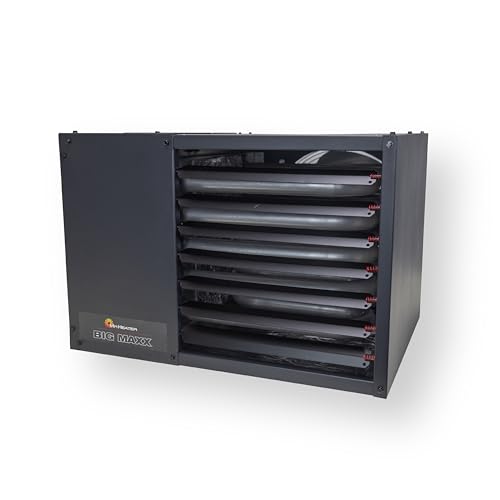
- 50,000 BTU units: These heaters warm up to 1,667 square feet, which roughly matches a typical 3-car garage. The physical cabinet measures about 15 inches high, 29 inches wide, and 26 inches deep, weighing around 60.3 pounds.
- 80,000 BTU units: For larger pole barns or workshops up to 2,667 square feet, an 80,000 BTU furnace provides heavier output. The metal cabinet measures roughly 22 inches high, 30 inches wide, and 27 inches deep, weighing around 78.15 pounds.
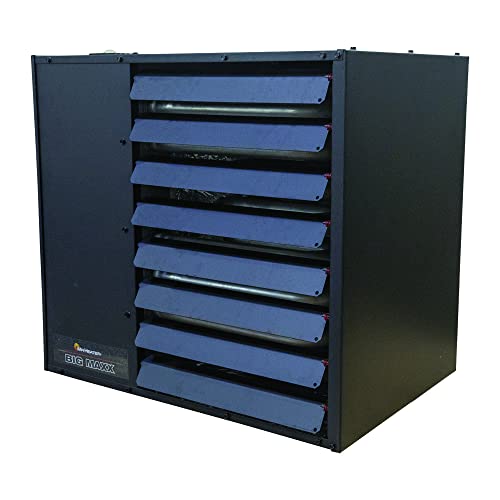
4. Heavy-Duty Commercial and Shop Heaters (125,000 BTU): For large commercial spaces, service bays, or drafty pole buildings, 125,000 BTU units deliver maximum warmth. A suspended forced-air unit in this category measures roughly 29.45 inches high, 31.85 inches wide, and 29.75 inches deep, weighing over 109 pounds. These large units feature electronic ignition to light the burner automatically and powered exhaust blowers to push combustion fumes safely out through a roof or side wall. Portable radiant salamander heaters also operate at 125,000 BTU for temporary job site heating, featuring a vertical cylinder footprint measuring roughly 16.14 by 16.4 inches and standing 35.04 inches tall.
How to Match Square Footage and Ceiling Height to the Right Size
Finding the correct heater capacity requires measuring your room and accounting for heat loss. Follow this simple checklist to determine how many BTUs your space requires:
- Measure the floor area: Multiply the room length by the room width to get total square footage. A room measuring 20 feet by 20 feet equals 400 square feet.
- Check the ceiling height: Standard room sizing guidelines assume an 8-foot ceiling. If your garage or workshop has 10-foot, 12-foot, or 14-foot ceilings, your heater must warm a much larger volume of air. Add roughly 15 to 25 percent more BTUs for every two feet of ceiling height above eight feet.
- Assess your insulation: A well-insulated finished room holds heat easily, needing roughly 30 to 40 BTUs per square foot. An uninsulated detached garage with an open metal roof and cold concrete slab may need 50 to 60 BTUs per square foot to stay comfortable. If you are struggling with a drafty sunroom, reviewing a dedicated heater for an enclosed porch can show you how drafts and glass exposure quickly increase heating demand.
- Consider local winter temperatures: If you live in a northern climate where winter temperatures routinely drop below zero, pick a unit at the higher end of the BTU range to ensure quick morning warm-ups.
What Goes Wrong When a Gas Heater Is Oversized or Undersized
Buying the wrong capacity gas heater creates frustrating, expensive problems that affect comfort, safety, and equipment lifespan.
If you buy an oversized gas heater, the unit will dump an immense blast of heat into the space and satisfy the thermostat in just two or three minutes. The heater then shuts off before warm air can circulate to corners, leaving cold spots near the floor while the ceiling overheats. Turning off and on too quickly before warming the room evenly is called short cycling. Short cycling causes rapid mechanical wear on gas valves, safety switches, and igniters. It also wastes fuel, because gas burners operate at their cleanest and most efficient levels only after running steadily for several minutes. In vent-free units, an oversized burner can also release excessive water vapor into a small room, causing condensation on windows and promoting mold growth.
If you buy an undersized gas heater, the unit will run continuously without ever raising the room to your target temperature. The burner fires without a break, driving up your monthly gas bill while mechanical components wear out under constant strain. In a drafty workshop, an undersized unit simply cannot overcome the cold air sinking down from the roof or seeping past garage door seals. For smaller work areas where adding gas piping seems excessive, installing an electric heater for a garage with a thermostat can sometimes provide a simpler alternative to undersized gas burners.
Clearance, Gas Pipe Supply, and Venting Checks Before You Buy
Before ordering a gas heater, walk through these five practical checks to make sure your space can physically accommodate the unit and support its fuel and venting needs.
- Measure your clearances around the mounting spot. Clearance is the safe open space needed around the hot unit. Check that the manufacturer's required distances from walls, ceilings, workbenches, and draperies can be met without blocking doors or walking paths.
Reason: Inadequate clearance allows hot air and radiant energy to heat nearby structural wood or drywall to dangerous temperatures, creating an immediate fire hazard. - Inspect your existing gas supply pipe diameter and fuel type. Check whether your gas supply is natural gas or propane, and confirm the pipe diameter leading to your installation spot. Small 10,000 BTU heaters can often run on a standard 3/8-inch or 1/2-inch gas line, but 80,000 to 125,000 BTU heaters generally require a dedicated 1/2-inch or 3/4-inch line to maintain proper fuel pressure.
Reason: An undersized supply pipe starves the heater of fuel, causing weak flames, burner flutter, poor combustion, and frequent safety shutoffs when other household gas appliances ignite. - Plan your exhaust venting route through the wall or ceiling. Look at where the exhaust pipe will exit the building before you purchase a vented heater. Vented forced-air units require metal flue pipes running straight up through the roof or horizontally through an exterior wall with approved wall thimbles.
Reason: Burning gas produces carbon monoxide and moisture that must exit the building safely, and venting pipes must maintain strict separation from combustible rafters and siding. - Confirm access to a grounded 120-volt electrical outlet. Check whether there is an electrical outlet within reach of your mounting location if you plan to install a forced-air heater. While small vent-free wall panels operate without electricity using manual pilot lights or battery igniters, larger ceiling heaters require electricity to power the electronic ignition, safety controls, and the fan that pushes warm air across the room.
Reason: Forced-air furnaces cannot operate without electric power, and running temporary extension cords to a permanent gas furnace violates national electrical safety codes. - Check local building codes and room restrictions. Contact your local building department or check municipal regulations regarding gas appliance installations. Many local codes strictly prohibit vent-free gas heaters in bedrooms, bathrooms, and confined spaces due to indoor air quality rules.
Reason: Installing a heater that violates local building regulations can void your homeowner insurance policy and create serious carbon monoxide hazards.
Choosing the Right Gas Heater Type for Your Space
Selecting the best heater comes down to how you plan to use the space and where the unit will live. For supplemental warmth in finished living areas, compact wall-mounted heaters offer quiet operation and a slim profile that stays out of your walking paths. Blue flame convection designs are ideal if you want steady, even warmth circulating throughout a room, while radiant plaque models work best if you spend most of your time sitting directly in front of the heater.
For garages, workshops, and outbuildings, ceiling-mounted forced-air unit heaters are usually the most practical choice. Suspending the heater overhead keeps your floor space open for vehicles, workbenches, and storage shelves. It also elevates the open flame well above flammable vapors that might linger near the garage floor from gasoline cans or paint solvents. When comparing models, always verify fuel compatibility, check whether mounting brackets are included, and look for recognized safety certification marks, such as CSA or UL listings, on the manufacturer data plate.
- BWP Score8.8
BWP Score is a ranking system developed by Bestwinterproducts.com. BWP score has no relationship or impact from any manufacturers or sales agent websites. Learn more
- BrandMr. Heater
- BWP Score8.5
BWP Score is a ranking system developed by Bestwinterproducts.com. BWP score has no relationship or impact from any manufacturers or sales agent websites. Learn more
- BrandMr. Heater

- BWP Score8.2
BWP Score is a ranking system developed by Bestwinterproducts.com. BWP score has no relationship or impact from any manufacturers or sales agent websites. Learn more
- BrandMr. Heater

- BWP Score8.0
BWP Score is a ranking system developed by Bestwinterproducts.com. BWP score has no relationship or impact from any manufacturers or sales agent websites. Learn more
- BrandMr. Heater

- BWP Score8.0
BWP Score is a ranking system developed by Bestwinterproducts.com. BWP score has no relationship or impact from any manufacturers or sales agent websites. Learn more
- BrandMr. Heater
- BWP Score8.0
BWP Score is a ranking system developed by Bestwinterproducts.com. BWP score has no relationship or impact from any manufacturers or sales agent websites. Learn more
- BrandMr. Heater

- BWP Score7.9
BWP Score is a ranking system developed by Bestwinterproducts.com. BWP score has no relationship or impact from any manufacturers or sales agent websites. Learn more
- BrandMr. Heater
Last update on 2026-10-11 / Affiliate links / Images, Product Titles, and Product Highlights from Amazon Product Advertising API
FAQs
Does gas heater size mean heating power or the physical box size?
In heating equipment, size primarily refers to heating power, which is rated in BTUs per hour. However, physical cabinet dimensions and weight also matter because they dictate how much wall, floor, or ceiling clearance you need for a safe installation. Always check both the BTU output and the physical measurements before buying.
What size gas heater do I need for a standard two-car garage?
A standard two-car garage measuring roughly 400 to 500 square feet typically requires a 45,000 to 50,000 BTU unit. If the garage has tall 10-foot or 12-foot ceilings, lacks wall insulation, or sits in a severe winter climate, stepping up to a 60,000 or 80,000 BTU heater ensures the room warms up quickly.
Do larger gas heaters require an electrical outlet?
Yes. While smaller vent-free wall heaters often run without household electricity, larger garage and workshop heaters use standard 120-volt power. They require electrical power to run the forced-air blower fan, power the exhaust vent motor, and operate the automatic electronic ignition system safely.
Can a gas heater be too big for a small room?
Yes, installing an oversized gas heater causes frequent short cycling, where the unit turns off and on rapidly without heating the room evenly. This rapid cycling wastes gas, wears out internal switches, and can release excessive moisture or combustion byproducts into small living spaces. You should always match the heater capacity to your actual room square footage.


Best Warm Winter Scarves 2026 For Cozy Comfort

Best Green Ski Goggles 2026 For Clear Vision On Slopes

12 Best Corner Electric Fireplace 2026: My Ultimate Guide To Pick One

Best Battery Powered Snow Blower 2026 For Effortless Snow Clearing

Best Ski Goggles Under 30 Inches For Crisp Vision And Comfort

Best Cooling Scarf 2026 For Instant Relief And Comfort

Fake Snow for Grass: Create a Realistic Winter Lawn Display

Dimplex Prism Wall Mount Fireplace: Sleek Heat With Modern Flame Style





