
Which Garage Heater Type Fits Your Space and Wiring?

Breath turns to mist the moment someone steps onto a freezing concrete slab to grab a tool. A radiant infrared heater is the best pick for warming a specific workbench instantly, while a 240-volt electric fan heater or vented gas unit works best for warming the entire room. Standard plug-in space heaters simply cannot produce enough heat to fight off a deep winter chill across open bays.
The right match depends on your available utility lines and how well your walls hold heat. An insulated building with an existing gas pipe or a heavy-duty electrical circuit can support steady, all-day warmth from corner to corner. A drafty space with basic outlets benefits much more from direct heat focused right where you stand. Here is how each option works so you can find the right fit for your wiring and routine.
Which heater type matches your garage layout?
A freezing garage feels colder than outdoors because a concrete slab acts like a giant ice block. Before buying equipment, check how well your garage holds heat, what utilities exist, and how you use the space. A heater that warms a tight shop can fail in a drafty bay.
If you spend hours on weekend projects in an insulated garage, you want even warmth from corner to corner. A forced-air heater (a heater with a fan blowing warm air) circulates heat across the entire room. But if your garage has bare wall studs or loose door seals, hot air rises straight to the roof or leaks out before warming your hands.
In a drafty or uninsulated space where you only work at a bench for an hour or two, radiant infrared heat works much better. Instead of trying to heat thousands of cubic feet of cold air, it directs heat straight at your body. You feel comfortable immediately without paying to heat the entire building.
Avoid using a standard bedroom space heater. In the United States, portable electric heaters draw up to 1,500 watts, roughly 12.5 amps on a standard 120-volt household circuit. While 1,500 watts warms a small 150-square-foot bedroom, it cannot warm a 400-square-foot garage surrounded by cold concrete. It runs continuously, spikes power bills, and leaves the room freezing.
Are electric fan heaters right for wired garages?
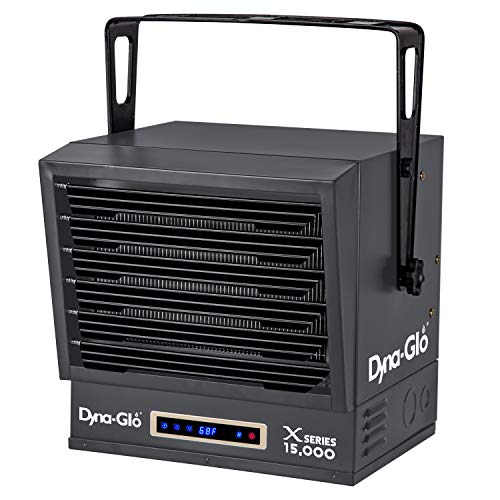
Electric forced-air units offer clean, hassle-free heating if your electrical panel has room. These heaters combine a heating element that warms up rapidly with an internal fan that pushes warm air across the room. Running on electricity, they produce no exhaust fumes, need no fuel tanks, and add zero indoor moisture.
Heating a typical two-car garage requires a 240-volt circuit instead of standard household 120 volts. A 240-volt line delivers the power needed to warm cold concrete and fight winter drafts. Most of these heaters are hardwired (wired straight into the breaker panel) on a dedicated 30-amp or 50-amp circuit. You cannot run them from a standard wall outlet. If your breaker panel sits in the garage with open slots, running a dedicated line is straightforward.
These units usually mount to ceiling joists or high on a wall bracket. Overhead mounting keeps floor space open for parking cars and moving work tables. Front louvers let you aim airflow down toward your workspace.
Most models feature a digital temperature dial that clicks on and off to hold your set warmth automatically. You can set the thermostat to 45 degrees Fahrenheit during the week to stop tools from rusting, then raise it to 65 degrees Fahrenheit when working. For steady climate control without fuel tanks, explore our guide to the best electric heater for garage with thermostat setups.
When does a gas heater make more sense?
Gas heaters provide immense heating power for large spaces. If you have a three-car garage, a pole barn, high ceilings, or an uninsulated shop, electric models can struggle or cost too much to run continuously. Gas units run on natural gas plumbed from your home utility line or liquid propane from an outdoor tank.
Gas heating power is measured in BTUs (British Thermal Units). While large electric heaters produce roughly 17,000 to 50,000 BTUs, gas units reach 50,000 to 100,000 BTUs or more. This output warms an ice-cold garage in twenty minutes, even during winter freezes.
Gas heaters come in two designs: vented and vent-free.
- Vented gas heaters: These units are vented (piped outside to dump exhaust) through a chimney pipe in the wall or roof. Vented heaters push all combustion fumes and moisture outside, keeping your shop air clean and dry.
- Vent-free gas heaters: These burn fuel directly inside the room without an exhaust pipe. While cheaper to install, burning fuel releases moisture. In a closed garage, this humidity condenses on cold steel tools and concrete floors, causing rust and slick surfaces while releasing exhaust directly into your breathing zone.
For an enclosed workshop, vented gas heaters are far safer and protect your tools from rust.
Why choose radiant infrared heat for your workbench?
Radiant infrared heaters warm objects instead of air. Radiant heat works like sunshine: the sun warms your clothes and skin directly even when the surrounding air feels cold.
Infrared waves travel through the air until they strike an object, like your workbench, tools, or body. The surface absorbs the rays and warms up instantly. This makes radiant heat ideal for drafty shops where doors open often. Opening a garage door dumps heated air into the driveway immediately. With infrared heat, warmth stays locked in your body and work surfaces.
Infrared heat is also great for woodworking, sanding, and painting. Fan heaters blow fine sawdust and debris into the air, ruining wet paint and irritating your lungs. Radiant heaters create no airflow, keeping your shop air completely still.
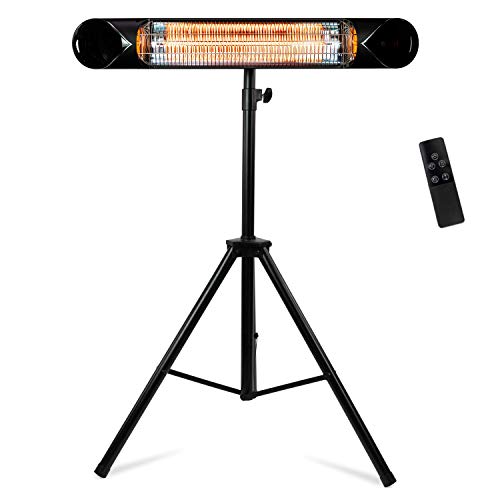
Radiant heaters come as ceiling bars, wall panels, or portable units on adjustable tripods. If you only use one corner of your garage for hobbies, placing an infrared heater over your bench gives you immediate comfort. Similar to heating open outdoor spaces, check out our guide on the best heater for enclosed porch areas to see how radiant warmth cuts through cold drafts.
How much heating power does your space actually need?
Choosing the wrong heater size creates headaches. An undersized unit runs nonstop without warming the room. An oversized unit cycles rapidly, creating sharp swings between hot and freezing.
Match your heating power to your floor plan and insulation:
- One-car garage (200 to 250 sq ft): An insulated one-car garage needs 2,000 to 3,000 watts of electric heat, or about 9,000 to 12,000 BTUs of gas power. A compact 240-volt electric unit or a radiant workbench heater handles this space well.
- Two-car garage (400 to 500 sq ft): An insulated two-car garage requires 4,000 to 6,000 watts of electric power (typically a 5,000-watt 240-volt heater) or 17,000 to 25,000 BTUs of gas heat. If the walls are uninsulated bare studs, step up to a 30,000 to 50,000 BTU unit to handle heat loss.
- Three-car garage or large shop (600 to 1,000 sq ft): Large spaces require 7,500 to 15,000 watts of electric power, or a 50,000 to 80,000 BTU gas heater. Make sure your electrical panel can support the high amperage before buying a large electric model.
Ceiling height also affects performance. Sizing rules assume an eight-foot ceiling. With ten-foot or twelve-foot ceilings, heat gathers near the roof while cold air pools at floor level. Look for heaters with downward louvers, or run a ceiling paddle fan on low reverse speed to push warm air down.
What safety hazards must you avoid in a garage?
Garages often hold lawn mowers, gas cans, paint thinners, and dry cardboard. Operating a powerful heat source requires strict attention to fire and electrical safety.
Follow these safety rules to protect your workshop and home:
- Keep a 3-foot safety buffer: Maintain at least 3 feet (36 inches) of clearance between your heater and combustible items. Keep cardboard boxes, cleaning rags, gasoline containers, and lumber piles away from the heating unit. Never drape wet clothes or towels over a heater to dry.
- Guard against flammable fumes: Gasoline and solvent vapors sink toward the floor. An open flame or glowing element near the ground can ignite them. Building codes often require mounting garage heaters at least 8 feet off the ground where cars park or fuels are stored.
- Never use extension cords: Portable 120-volt space heaters pull 12.5 amps continuously. Standard extension cords or power strips can overheat, melt, and ignite. Always plug portable units directly into a grounded wall outlet.
- Check for safety shutoffs: If using a portable heater, ensure it has a tip-over safety switch that cuts power instantly if the unit is knocked over or tilted, and an automatic overheat sensor that shuts the unit off if internal parts get dangerously hot.
- Install carbon monoxide alarms: Any fuel-burning gas heater requires a battery-backed carbon monoxide alarm installed at eye level in the garage, plus another inside your home near the garage entrance door.
If an outlet feels hot, a breaker trips repeatedly, or you smell gas, turn the unit off immediately, disconnect the power, and call a qualified professional.
What should you check before picking a model?
Before buying a garage heater, inspect your space and utility setup. Check your breaker panel for open double-pole slots to support a 240-volt line, or check the route from your gas meter for a natural gas unit. Measure ceiling height and wall clearances so an overhead model clears vehicle roofs and garage door tracks.
Think about your heating habits as well. If you only spend thirty minutes in the garage to make quick cuts or grab garden tools, a directional infrared heater mounted over your bench provides instant comfort with zero warmup time. If you spend full days rebuilding cars or working out, a hardwired electric fan heater or a vented gas furnace delivers steady, room-filling warmth. Always verify that your chosen model carries a recognized safety certification mark, such as UL, ETL, or CSA, on the product label.

- BWP Score8.8
BWP Score is a ranking system developed by Bestwinterproducts.com. BWP score has no relationship or impact from any manufacturers or sales agent websites. Learn more
- BrandMr. Heater
- BWP Score8.6
BWP Score is a ranking system developed by Bestwinterproducts.com. BWP score has no relationship or impact from any manufacturers or sales agent websites. Learn more
- BrandDyna-Glo

- BWP Score8.6
BWP Score is a ranking system developed by Bestwinterproducts.com. BWP score has no relationship or impact from any manufacturers or sales agent websites. Learn more
- BrandHeat Storm

- BWP Score8.6
BWP Score is a ranking system developed by Bestwinterproducts.com. BWP score has no relationship or impact from any manufacturers or sales agent websites. Learn more
- BrandMr. Heater
- BWP Score8.4
BWP Score is a ranking system developed by Bestwinterproducts.com. BWP score has no relationship or impact from any manufacturers or sales agent websites. Learn more
- BrandBriza

- BWP Score8.4
BWP Score is a ranking system developed by Bestwinterproducts.com. BWP score has no relationship or impact from any manufacturers or sales agent websites. Learn more
- BrandDR. INFRARED HEATER

- BWP Score8.4
BWP Score is a ranking system developed by Bestwinterproducts.com. BWP score has no relationship or impact from any manufacturers or sales agent websites. Learn more
- BrandVAGKRI

- BWP Score8.0
BWP Score is a ranking system developed by Bestwinterproducts.com. BWP score has no relationship or impact from any manufacturers or sales agent websites. Learn more
- BrandENVI
Last update on 2026-09-29 / Affiliate links / Images, Product Titles, and Product Highlights from Amazon Product Advertising API
FAQs: What Else Should You Know?
Can a standard 120-volt outlet heat a two-car garage?
No, a standard 120-volt household outlet cannot warm a two-car garage during freezing weather. Standard 120-volt outlets max out at 1,500 watts, which only heats an insulated room of about 150 square feet. In a cold 400-square-foot garage, a 120-volt heater runs continuously without raising the overall temperature.
Is gas or electric cheaper for heating a garage?
Operating costs depend on regional utility rates, but natural gas is usually cheaper per hour of heat output than electricity. However, electric heaters cost far less to install because they require no gas piping or exhaust vents through the roof. If you only heat your garage occasionally on weekends, the lower upfront installation cost of an electric unit often makes it more practical.
Do gas garage heaters always need an outside vent?
Vented gas heaters are strongly recommended for any enclosed garage or workshop. Fuel combustion generates water vapor and carbon monoxide, which vent pipes safely exhaust outdoors. Unvented heaters trap moisture indoors, causing heavy condensation that rusts hand tools and creates damp, unhealthy indoor air.
How can I stop cold garage door drafts?
Installing fresh rubber weatherstripping along the bottom of the garage door and vinyl trim seals along the sides stops cold air before it enters. Even the best garage heater will struggle if winter winds blow freely under the door. Sealing perimeter gaps keeps heat inside and reduces your operating costs.


Best Warm Winter Scarves 2026 For Cozy Comfort

Best Green Ski Goggles 2026 For Clear Vision On Slopes

12 Best Corner Electric Fireplace 2026: My Ultimate Guide To Pick One

Best Battery Powered Snow Blower 2026 For Effortless Snow Clearing

Best Ski Goggles Under 30 Inches For Crisp Vision And Comfort

Best Cooling Scarf 2026 For Instant Relief And Comfort

Fake Snow for Grass: Create a Realistic Winter Lawn Display

Dimplex Prism Wall Mount Fireplace: Sleek Heat With Modern Flame Style





