
Which Type of Space Heater Warms a Cold Basement?

Stepping off the bottom basement stair onto cold concrete feels like walking straight into an open refrigerator. For a finished, insulated basement room, an oil-filled radiator or convection panel is the best choice because it quietly warms the circulating air and holds that heat for hours. In an open, drafty space where bare masonry pulls heat away fast, an infrared or ceramic heater works better by aiming direct warmth straight at your body.
The right choice depends on your walls and how you use the space. Bare concrete drains heat quickly, which can make whole-room heaters run nonstop and spike electric bills. How long you stay down there matters just as much, along with whether your outlets share a circuit breaker with a dehumidifier or freezer. Here is how each heater style tackles underground chill and how to pick the safest setup for your home.
Match the Heater Style to How You Use the Underground Space
Basements present a unique heating challenge because surrounding earth and foundation walls stay naturally cool. Sinking cold air from upstairs also settles across the basement floor. Choosing the right heater depends on how you use the space and whether you need to warm an entire room or just your immediate seating spot.
Convection heaters work by warming the circulating air in the room. Cool air enters the bottom of the unit, warms over internal elements, and rises toward the ceiling. As warm air rises, it pushes cooler ceiling air down, creating a natural circulation loop. A silent radiator heater that circulates steady, lasting warmth or a slim convection panel takes thirty to forty-five minutes to warm a cold room. Once warm, it delivers quiet heat that lingers for hours. This style is best for an enclosed basement bedroom, home office, or family room where you spend hours at a time.
Radiant and infrared heaters warm people and furniture directly like sunlight. Their invisible heat waves travel straight through the air without heating the room volume first. When those waves contact your body, clothes, or desk, those surfaces absorb the warmth instantly. If your basement is an open, uninsulated concrete space, warming the air is nearly impossible. A radiant heater keeps you warm where you sit, even if the room air remains chilled. This makes radiant heat ideal for workbench tables or laundry stations.
Ceramic fan heaters deliver the fastest warmth. A ceramic heating element that warms up in seconds pairs with a fan that pushes warm air across the room. You feel heated air within seconds of turning the power dial. Ceramic towers excel at taking the chill off a small play area or warming your legs during short visits. If you manage other unheated spaces, checking out a heater to warm drafty spaces illustrates similar airflow strategies for poorly sealed rooms.
Check Your Walls and Floors Before Relying on Air Heating
Look closely at your basement construction before deciding on a heater. Underground soil remains between 50 and 60 degrees Fahrenheit year-round. While underground earth prevents subzero outdoor freezes, bare concrete walls and slabs act like thermal sponges. They continuously absorb heat from indoor air and pull it straight into the cold ground.
In a finished basement with insulated stud walls and drywall, heat stays inside the room much like upstairs living spaces. The insulation prevents heat loss into the foundation, allowing a convection heater to warm the circulating air in the room efficiently. In these rooms, a unit with a digital temperature dial that clicks on and off to hold your set warmth will maintain a comfortable 68 to 72 degrees Fahrenheit without running constantly.
In an unfinished basement, bare concrete walls absorb warm air as fast as a portable heater generates it. Cold concrete floors also chill the air right around your feet. Placing a convection heater in an open unfinished basement means the unit runs constantly on high without warming the room. In unfinished spaces, skip whole-room air heating and rely on radiant heat aimed at your body. In larger utility spaces, reviewing how an electric heater for steady garage warmth operates provides helpful strategies for managing cold concrete floors.
Audit Your Basement Circuit to Prevent Tripped Breakers and Blown Fuses
Electric space heaters draw substantial electrical power. In the United States, portable electric heaters draw up to 1,500 watts on high, which equals about 12.5 amps on a standard 120-volt household circuit. Most residential basement circuits use 15-amp breakers. Electrical safety rules state that continuous loads should not exceed 80 percent of a circuit's capacity. On a 15-amp circuit, that safe limit is 12 amps.
Running a 1,500-watt heater on high pushes you right to that limit. If another appliance starts up on the same line, the breaker (an electrical safety switch that cuts power during an overload) will trip to prevent wall wires from overheating. Follow this electrical checklist before turning on your heater:
- Check your electrical panel to see whether your basement circuit breaker is rated for 15 amps or 20 amps. A 20-amp breaker safely supports up to 16 amps of continuous load.
- Identify all shared outlets on the circuit. Freezers, sump pumps, dehumidifiers, and desktop computers should be plugged into a separate electrical branch.
- Plug the heater directly into a wall outlet. Never use an extension cord, power strip, or surge protector. Standard extension cord wires are too light for a 12.5-amp continuous load and can overheat quickly, creating a fire risk.
- Use a lower heat setting or power level whenever possible. Dropping a 1,500-watt unit to an 800-watt or 1,000-watt low setting lowers the draw to around 6.7 to 8.3 amps, leaving plenty of power for lights and laptops.
- Touch the outlet faceplate after twenty minutes of runtime. If the plastic feels uncomfortably hot, or if the plug fits loosely, turn off the unit, unplug it, and have a licensed electrician replace the outlet.
Inspect the Unit for Essential Safety Shutoffs and Safe Clearances
Using a space heater downstairs requires strict safety habits. Basements often hold stored boxes, laundry, and extra furniture. Clutter combined with electric heat creates real fire risks if you overlook basic safety features.
Verify that your heater includes these core safety shutoffs before setting it up downstairs:
- A tip-over safety switch that cuts power instantly if the unit is knocked over or tilted. Basement floors are often uneven, and pets or children can easily bump a floor heater. An internal sensor shuts off power the moment the base leaves flat contact with the floor.
- An automatic overheat sensor that shuts the unit off if internal parts get dangerously hot. If blankets, dust, or clothing block the intake grilles, this sensor cuts power before plastic or wires overheat.
- Flame-retardant housing materials. Look for units built with V0 flame-retardant plastic or solid metal casings. Check the product label on the unit for an official safety certification mark from UL or ETL.
- A mandatory 3-foot safety buffer. Keep all sides of the heater at least 3 feet (36 inches) away from curtains, furniture, storage boxes, and pet beds.
- Protection from basement moisture. Never use an electric heater on damp concrete, near an active sump pit, or beside a dehumidifier drain. High humidity and damp floors increase electrical shock risks and can corrode internal connections.
- Attentive supervision. Never leave a portable heater running while you are sleeping in an unmonitored basement or away from home. Turn the unit off and unplug it whenever you head upstairs.
Elevate and Position the Unit to Beat Heavy Floor Drafts
Cold air always settles at the lowest point of your home. In a basement, this creates a dense pool of chilly air right across the floor slab. Placing a heater haphazardly forces it to fight this cold layer inefficiently. Follow these steps to position your heater for maximum warmth:
- Elevate the heater off bare concrete. Cold concrete slabs draw heat away through the bottom casing. Place the unit on an area rug or a low, fire-resistant riser, ensuring the surface is level so the tip-over switch engages.
- Angle airflow toward the center of your living space. Do not point a fan heater directly at cold concrete walls. Exterior foundation walls absorb heat rapidly, wasting energy to the cold ground outside.
- Position the heater between you and incoming drafts. Cold air frequently spills down basement stairwells or leaks around egress windows. Placing the heater between that cold source and your chair warms incoming air before it reaches you.
- Maintain clear space around all grilles. Keep at least 3 feet of open space in front of the heat outlet and 1 foot behind the rear intake so the internal element receives steady airflow.
- Run a ceiling fan in reverse on low. Because warm air rises, basement ceiling air can be ten degrees warmer than the floor. Running a ceiling fan clockwise on its lowest speed pushes that trapped warm air gently down walls and across the floor.
Choose Between a Portable Tower and a Mounted Wall Panel
Choosing the right heater style for your basement usually comes down to selecting between a portable ceramic tower and a wall-mounted convection panel. Each design solves specific space challenges in finished or unfinished basements.
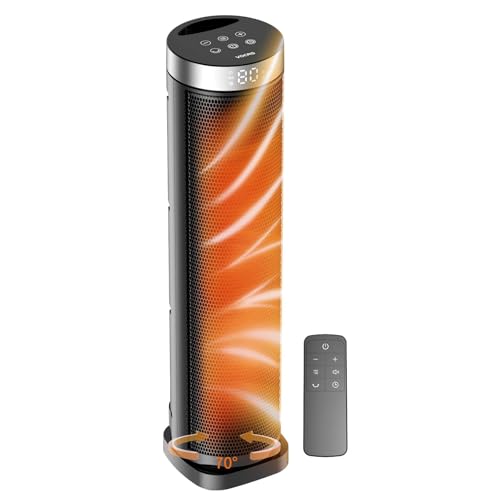
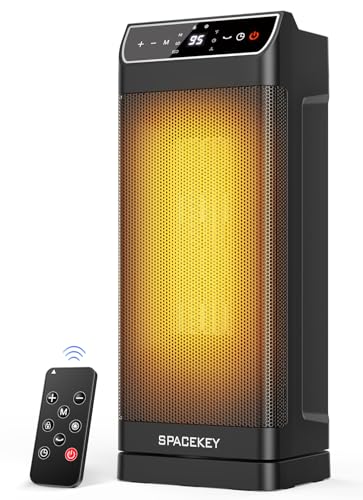
Portable ceramic towers provide rapid, flexible spot heat. Their upright design saves floor space, and wide oscillation sweeps warm air across seated knee and chest height. They move easily from a home office desk to a family room sofa. When shopping for a tower, look for a wide, stable base that resists tipping, a remote control for easy adjustments from across the room, and multiple heat settings to help manage circuit breaker limits.
Wall-mounted convection panels deliver quiet, steady warmth for finished basement rooms. Hanging a slim panel directly on drywall keeps floor space completely clear and eliminates tripping over cords. They circulate warmth naturally without fan noise, making them ideal for bedrooms or media rooms. Before purchasing, verify your wall stud spacing for the mounting brackets and confirm that the power cord safely reaches a dedicated wall outlet.

- BWP Score10.0
BWP Score is a ranking system developed by Bestwinterproducts.com. BWP score has no relationship or impact from any manufacturers or sales agent websites. Learn more
- BrandFLOWBREEZE
- BWP Score9.6
BWP Score is a ranking system developed by Bestwinterproducts.com. BWP score has no relationship or impact from any manufacturers or sales agent websites. Learn more
- BrandVOCRS
- BWP Score9.6
BWP Score is a ranking system developed by Bestwinterproducts.com. BWP score has no relationship or impact from any manufacturers or sales agent websites. Learn more
- BrandSpacekey

- BWP Score9.2
BWP Score is a ranking system developed by Bestwinterproducts.com. BWP score has no relationship or impact from any manufacturers or sales agent websites. Learn more
- BrandDREO

- BWP Score9.0
BWP Score is a ranking system developed by Bestwinterproducts.com. BWP score has no relationship or impact from any manufacturers or sales agent websites. Learn more
- BrandDREO

- BWP Score9.0
BWP Score is a ranking system developed by Bestwinterproducts.com. BWP score has no relationship or impact from any manufacturers or sales agent websites. Learn more
- BrandLasko

- BWP Score8.8
BWP Score is a ranking system developed by Bestwinterproducts.com. BWP score has no relationship or impact from any manufacturers or sales agent websites. Learn more
- BrandGiveBest

- BWP Score8.8
BWP Score is a ranking system developed by Bestwinterproducts.com. BWP score has no relationship or impact from any manufacturers or sales agent websites. Learn more
- BrandDREO

- BWP Score8.0
BWP Score is a ranking system developed by Bestwinterproducts.com. BWP score has no relationship or impact from any manufacturers or sales agent websites. Learn more
- BrandBallu
Last update on 2026-09-29 / Affiliate links / Images, Product Titles, and Product Highlights from Amazon Product Advertising API
FAQs
Can a space heater warm a large, unfinished basement?
A standard 1,500-watt space heater cannot warm a large, open, unfinished basement because bare concrete walls absorb heat faster than the heater can output it. In an uninsulated basement, use an infrared radiant heater directed at your body rather than trying to heat the air. Radiant heat warms your clothing and skin directly, keeping you comfortable even in a cold room.
Will a 1,500-watt space heater trip my basement circuit breaker?
A 1,500-watt heater draws about 12.5 amps, which consumes most of the capacity on a standard 15-amp household circuit. If other appliances like a freezer, sump pump, or computer share that circuit, turning the heater on high will likely trip the breaker. To prevent power interruptions, plug the heater into a dedicated outlet or run it on a lower heat setting like 750 or 1,000 watts.
What is the best heater placement for a cold basement floor?
The best placement is positioning the heater a few feet away from cold exterior walls, angled inward toward your seating area, and set on an area rug rather than bare concrete. Elevating the unit above cold masonry stops the floor from leeching away heat. Always maintain 3 feet of open clearance around the unit for safe, unrestricted air circulation.
Does basement humidity affect space heater safety?
High basement humidity can corrode electrical connections over time and create shock hazards if condensation forms inside the heater. Never place a space heater on damp concrete, near a sump pump, or beside a dehumidifier drain hose. If your basement has damp air, operate a dehumidifier to dry the room before running an electric space heater.


Best Warm Winter Scarves 2026 For Cozy Comfort

Best Green Ski Goggles 2026 For Clear Vision On Slopes

12 Best Corner Electric Fireplace 2026: My Ultimate Guide To Pick One

Best Battery Powered Snow Blower 2026 For Effortless Snow Clearing

Best Ski Goggles Under 30 Inches For Crisp Vision And Comfort

Best Cooling Scarf 2026 For Instant Relief And Comfort

Fake Snow for Grass: Create a Realistic Winter Lawn Display

Dimplex Prism Wall Mount Fireplace: Sleek Heat With Modern Flame Style





