
Why The Dreo 42 Heater Fan Delivers Even Winter Warmth

Cold air sneaks across the rug while a small floor heater buzzes loudly, scorching ankles while leaving shoulders shivering. Switching to a tall tower heater fan fixes that problem because its height and broad swing spread warm air evenly from the floor up to your chest. Instead of blasting one concentrated hot spot, the vertical vents release steady heat that pushes deep into drafts to keep the whole room comfortable.
How well this setup works for your home depends on a few practical details. The standard heating element handles enclosed bedrooms and average living spaces well, but tall vaulted ceilings or drafty open layouts take longer to warm up. It is an ideal fit if you want whisper-quiet warmth for sleeping and a breeze you can keep using all summer. Here is how the design holds up against cold winter nights.
How a 42-Inch Tower Spreads Heat Better Than Floor Heaters
Standard compact space heaters sit low to the ground and push a narrow beam of heat across the baseboards. Because warm air naturally rises toward the ceiling, that heat lifts above your head almost immediately, leaving your ankles warm while your chest, neck, and hands remain cold. You end up cranking the temperature dial higher, waiting for the upper air layers to slowly fill the room from the ceiling down.
A 42-inch tower heater changes this pattern by moving air across a long vertical column. The tall front grille pushes heated air from shin level up through your torso in a single continuous stream. When you sit on a couch or work at your desk, the air warms your core immediately rather than dissipating at your feet. An upgraded 1800 RPM motor pushes up to 1585 CFM of air volume (the total amount of air moved) up to 40 feet across the room.
Wide 120-degree oscillation spreads that vertical curtain of warmth smoothly across the entire width of the space. Instead of a narrow hot spot that roasts one piece of furniture, the moving airflow steadily circulates the room air volume. A ceramic heating element that warms up in seconds creates warmth immediately after you tap the power button. This steady air movement breaks up chilly drafts near uninsulated windows and doorways, making cold rooms feel evenly comfortable much faster.
Whisper-Quiet Sound Levels for Bedroom Sleep and Work
Most small space heaters make a distracting racket. Traditional box heaters rely on small, high-pitched fan blades that buzz, rattle against the casing, and click loudly whenever the heating coils turn on or off. In a quiet bedroom or during an office conference call, that mechanical buzzing breaks your concentration and can wake light sleepers throughout the night.
The Dreo 42-inch tower uses a smooth DC motor engineered to run as quietly as 25 decibels (a decibel scale measures loudness level). To put that in perspective, 25 decibels is quieter than a soft whisper or the faint rustling of dry leaves outside a closed window. The airflow hums along in a steady, gentle background tone that blends naturally into a silent room. Because the motor stays consistent and avoids harsh mechanical clicking, your ears quickly tune it out.
Nighttime comfort also depends on staying in a dark, undisturbed environment. Bright digital displays can illuminate a dark bedroom like a nightlight, making it harder to fall into a deep sleep. This tower design allows you to dim or turn off the display lighting while the unit continues heating. You can also set the built-in 12-hour timer to shut the fan off automatically after you fall asleep, or run it through the early morning hours when bedroom temperatures drop the most.
Managing Power Draw, Heat Settings, and Your Electric Bill
Electric space heaters carry a reputation for spiking utility bills, but high costs usually happen when heaters run at full blast without temperature control. In standard US homes, portable electric heaters draw up to 1500 watts of power on their highest setting. That equals roughly 12.5 amps of electrical current on a standard 120-volt household circuit. Using that maximum output all day will drive up your power bill, but smart power management keeps warmth affordable.
A reliable heating rule of thumb is that 10 watts warms approximately one square foot of living space. That means a 1500-watt heat setting easily handles a closed 150-square-foot bedroom on cold winter nights, or provides focused warmth around your seating area in a larger 300-square-foot living room. With 5 distinct heat settings and an automatic energy-saving setting (ECO mode), the heater dials back its electrical draw once the room reaches your selected warmth. The digital temperature dial clicks on and off to hold your set comfort without wasting electricity. If you want to keep energy use steady across chilly spaces, using an electric heater with a thermostat helps balance steady warmth against utility costs.
Use this quick setup checklist to keep your electricity safe and your monthly power bill under control:
- Plug the power cord directly into a standard 120-volt wall outlet, and never run the heater through an extension cord, power strip, or surge protector.
- Set your target room temperature between 68°F and 72°F rather than dialing it to maximum heat.
- Close bedroom and living room doors to seal in the warm air volume and prevent your heater from trying to warm the entire house.
- Confirm that other high-wattage household appliances, such as hair dryers, coffee makers, or irons, are not plugged into the same 15-amp electrical circuit.
- Switch to lower power levels or rely on the automatic ECO mode once the room reaches a comfortable temperature.
Essential Safety Features for Drafty Rooms, Kids, and Pets
Space heaters produce intense heat, making safety features essential for households with children, pets, or busy living areas. Tall tower heaters have a narrow footprint, measuring roughly 12.91 inches by 12.91 inches at the base. Because a 42-inch unit stands upright, it requires a weighted, stable foundation to prevent tipping when bumped by a dog tail or a vacuum cleaner. At 13.46 pounds, the base stays planted on hard floors and low-pile rugs, but safety shutoffs are still critical.
Every reliable space heater needs an internal tip-over safety switch that cuts power instantly if the unit is knocked over or tilted. If a pet jostles the tower past a safe angle, the mechanical switch disengages and cuts electrical current to the ceramic heating element immediately. Alongside the tip switch, an automatic overheat sensor shuts the unit off if internal parts get dangerously hot. This prevents thermal hazards if clothing, blankets, or curtains accidentally drift against the back air intake grille.
Maintaining a safe space around the heater is just as important as internal sensors. Always keep a strict 3-foot safety buffer around the tower. That means positioning the unit at least 3 feet (36 inches) away from bedding, upholstered couches, curtains, paperwork, and pet beds. If you are trying to heat drafty, uninsulated areas like an enclosed sunroom or porch, you may want to review how to pick a heater to warm drafty spaces safely while maintaining clean air pathways.
If your heater ever shuts off suddenly on its own, follow these safe steps in order. First, switch the power button off immediately. Second, unplug the cord from the wall outlet. Third, let the entire unit sit and cool down completely for at least 20 minutes before touching the housing. Check the back intake and front grille for dust clogs or pet hair, and wipe them clean with a dry cloth. If the unit continues to shut off, or if the wall outlet feels hot to the touch or smells like warm plastic, stop using the outlet immediately and contact a licensed electrician to inspect your household wiring.
What to Look for in an All-Season Tower Heater Fan
When shopping for a tower heater fan, one of the biggest practical benefits is finding a design that works throughout the entire year. Traditional space heaters sit in a dark bedroom closet or basement storage bin for nine months out of the year, gathering dust while taking up valuable storage space. An all-season tower solves that storage issue by converting into a high-powered cooling fan when warm weather arrives.
Before buying a dual-purpose tower, check the range of air controls it offers. A quality multi-season unit should feature distinct heat levels for winter alongside a wide range of cooling fan speeds for summer. Basic combo fans often skimp on summer airflow, offering only two or three sluggish fan speeds that do little to cool a stuffy room. Look for a unit that provides high air velocity and a smooth motor capable of blowing air deep across a large living room or master bedroom.
Oscillation range and remote convenience are equally important when comparing tower designs. A tower that sweeps across a wide arc, ideally 90 to 120 degrees, will push air into every corner of the room rather than concentrating warmth or cold air onto a single spot. A compact remote control lets you adjust the temperature setting, swap between heating and cooling modes, or start the timer without having to get out of bed or stand up from your desk.
Finally, check the safety listing on the manufacturer label located on the back or bottom of the housing. Look for recognized US safety marks, such as UL or ETL listings, which confirm that the electrical parts and heating elements meet strict national safety standards. A broad, weighted base and a wipeable intake filter will ensure that the unit remains safe, steady, and easy to keep clean through every season of the year.
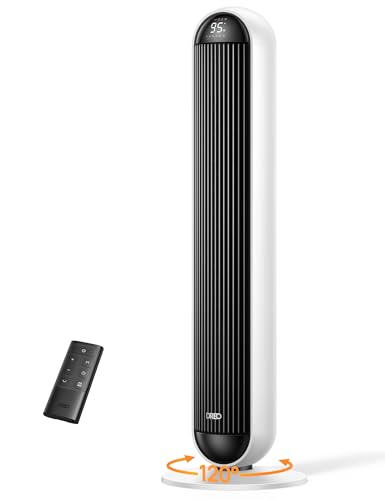
- BWP Score7.4
BWP Score is a ranking system developed by Bestwinterproducts.com. BWP score has no relationship or impact from any manufacturers or sales agent websites. Learn more
- BrandDREO

- BWP Score8.7
BWP Score is a ranking system developed by Bestwinterproducts.com. BWP score has no relationship or impact from any manufacturers or sales agent websites. Learn more
- BrandDREO
Last update on 2026-10-07 / Affiliate links / Images, Product Titles, and Product Highlights from Amazon Product Advertising API
FAQs
How far away should I sit or sleep from a 42-inch tower heater?
Place the tower heater at least 3 feet away from your body, bed, and any furniture. This 3-foot safety buffer prevents skin dryness, keeps blankets away from hot grilles, and lets the oscillating vertical air spread evenly across the room before reaching you.
Can I plug a 1500-watt tower heater into an extension cord or surge protector?
No, you should always plug a 1500-watt space heater directly into a standard household wall outlet. Extension cords, power strips, and surge protectors are rarely rated to handle continuous 12.5-amp electrical loads, which causes them to overheat, melt, and create serious fire hazards.
How do I clean the dust out of a tower heater fan?
Always turn off and unplug the tower heater from the wall, allowing it to cool down completely before cleaning. Use the soft brush attachment on your vacuum cleaner to gently clear dust and pet fur from the front grille and rear air intake vents. Wipe down the plastic housing with a dry microfiber cloth, and never spray liquid cleaners or water directly into the heater vents.


Best Warm Winter Scarves 2026 For Cozy Comfort

Best Green Ski Goggles 2026 For Clear Vision On Slopes

12 Best Corner Electric Fireplace 2026: My Ultimate Guide To Pick One

Best Battery Powered Snow Blower 2026 For Effortless Snow Clearing

Best Ski Goggles Under 30 Inches For Crisp Vision And Comfort

Best Cooling Scarf 2026 For Instant Relief And Comfort

Fake Snow for Grass: Create a Realistic Winter Lawn Display

Dimplex Prism Wall Mount Fireplace: Sleek Heat With Modern Flame Style





