
How Many Cords of Wood Do You Need for Winter?

Most homes rely on three to six full cords of firewood to stay warm through a typical winter. That number drops down to one or two cords if the fire only crackles on chilly evenings or weekend mornings. Guessing too low leaves everyone shivering in January, right when dry, seasoned wood sells out and deliveries get expensive.
A few everyday factors shift your exact stack size. Drafty rooms and subzero northern freezes eat through logs much faster than a mild winter in a well-insulated home. Dense hardwoods like oak also hold heat far longer than fast-burning softwoods, and an airtight wood stove uses a fraction of the fuel an open fireplace wastes. Here is how to figure out your household burn rate so your pile lasts clean through spring.
How Your Heating Role Changes Your Winter Wood Supply
The total volume of wood you need depends on whether your wood stove carries the entire heating load or simply provides cozy warmth after work. When a wood stove serves as your primary heat source, you burn logs around the clock from late autumn until spring thaw. That continuous burn rate requires a substantial woodpile to keep the house warm through blizzards and sub-zero nights. Most families who heat entirely with wood go through three to six full cords across a normal winter.
If you use wood strictly for supplemental warmth, your fuel demands drop significantly. Supplemental heating usually means lighting the fire at five in the evening to take the chill out of the living room and turning the central thermostat down overnight. Homes running this schedule typically burn one to two full cords between November and March. The wood takes the pressure off your furnace without demanding that you haul logs all weekend.
Occasional burning in an open fireplace is a different category altogether. Open masonry hearths draw large volumes of warm air out of the room and up the chimney, which makes them lovely to look at but inefficient for heating. If you only light a fire for holiday gatherings, football weekends, or freezing Sunday afternoons, a half cord to one full cord covers the entire season. Burning wood this way creates atmosphere rather than reliable daily BTUs.
Your appliance type also makes a major difference in fuel consumption. A modern airtight wood stove with secondary burn tubes or a catalytic combustor extracts maximum heat from every log, stretching your woodpile much farther. In contrast, an uncertified vintage stove or an open brick fireplace swallows three times as much wood while producing far less steady warmth in your living space.
Full Cord vs Face Cord: How to Avoid Getting Shorted on Delivery
Firewood fraud is common because many new wood burners do not know official lumber volume measurements. By legal definition across the United States, a full cord of firewood measures 128 cubic feet of tightly stacked wood, bark, and air space. The standard stack measures four feet high, four feet deep, and eight feet long. When logs are cut to the common sixteen-inch stove length, a full cord consists of three parallel rows stacked four feet high and eight feet long.
A face cord is much smaller and represents only a fraction of a full cord. A face cord measures four feet high and eight feet long, but it is only one log deep. If the logs are cut to sixteen inches, that single row equals roughly one-third of a full cord, or about forty-three cubic feet. Sellers often advertise a cheap price for a cord, but they deliver a single face cord from the bed of a standard pickup truck. If you expect a full cord and receive a face cord, you run out of heat before January even arrives.
Loose volume also trips up unwary buyers. When firewood is thrown loosely into a dump trailer rather than neatly stacked, it takes up about thirty percent more physical space. A loose pile that measures 180 cubic feet settles down into roughly 128 cubic feet once you stack it neatly along your fence line. Always ask your supplier whether their quoted price reflects a stacked full cord of 128 cubic feet or a loose truckload.
Wood quality matters just as much as stack volume. Seasoned firewood is dry wood that lights easily and burns clean, with a moisture content below twenty percent. Green, unseasoned wood holds gallons of trapped water inside the grain. Burning wet wood wastes heat energy just boiling off steam, and it coats your chimney pipe with creosote (dark, tar-like chimney soot that causes flue fires). When your wood arrives, look for dark gray ends with visible drying cracks. Bang two pieces together: dry logs ring with a hollow, bowling-pin sound, while wet logs make a dull, wet thud.
Checklist: Conditions That Speed Up Your Daily Wood Burn
Your burn rate is never completely static from week to week. Several home and weather conditions will chew through your wood stack much faster than the baseline averages suggest. Review these factors before placing your seasonal firewood order:
- Regional winter severity: Living in the northern tier states, the Upper Midwest, or high mountain valleys brings long stretches of sub-zero temperatures. A six-month freeze consumes twice the fuel of a mild winter in the mid-Atlantic or Pacific Northwest.
- Home air sealing and insulation levels: Drafty older homes with thin fiberglass insulation lose warm air quickly through the ceiling and around window frames. You can learn simple draft-stopping techniques in our guide on how to keep warm in winter in the house to keep your stove heat inside where it belongs.
- Wood species density: Dense hardwoods like red oak, hard maple, hickory, and black locust burn slowly and leave hot, long-lasting coals. Softwoods like pine, fir, and spruce burn rapidly with intense short-lived flames, meaning you must reload your firebox twice as often.
- Living space square footage: Heating a 2,500-square-foot two-story home naturally takes more BTUs than keeping an 800-square-foot hunting cabin comfortable. Zoned doors and ceiling fans help push heat from the stove room to remote bedrooms.
- Daily attendance habits: If someone stays home all day to feed the fire every few hours, the stove runs continuously at an optimal cruising temperature. If the house sits empty for twelve hours while you work, the stove cools down, requiring more kindling and small splits to bring the masonry back to temperature every evening.
How to Calculate Your Firewood Needs in Five Steps
You do not need complicated forestry calculations to estimate your winter supply. By watching how your stove behaves during a regular cold week, you can calculate your exact woodpile needs using these five simple checks.
- Count your average daily stove reloads during cold weather. Watch how many times you open the stove door to load fuel during an average twenty-four-hour period. Most families heating primarily with wood reload their firebox three to five times a day. Reason: This daily reload cycle establishes your baseline fuel consumption before weather changes.
- Tally the number of split logs used in every firebox fill. Take note of how many average-sized logs fit into your stove chamber per reload cycle. A standard medium firebox usually holds four to six split logs when packed for an overnight or daytime burn. Reason: Knowing your logs per reload translates your appliance volume into physical piece counts.
- Map your active heating season in total calendar days. Count the weeks between the first steady autumn chill and the final spring cold snap in your county. In colder zones, this active burn window typically spans about 150 to 180 continuous days. Reason: A five-month winter requires vastly more total wood volume than a ninety-day freeze period.
- Convert your total seasonal log count into full cords. Multiply your daily reloads by your logs per reload, then multiply that total by your seasonal days. A full cord of standard sixteen-inch split hardwood contains roughly 600 to 800 pieces of wood. Divide your total seasonal log count by 700 to find your baseline cords. Reason: Translating piece counts into full cords allows you to buy or cut bulk timber accurately.
- Add a twenty percent safety cushion to your final number. Take your baseline cord total and multiply it by 1.2 to create an emergency reserve. If your calculation calls for four cords, order or split five cords before cold weather arrives. Reason: Extended spring freezes or snowstorms can trap you at home when commercial firewood sellers are completely sold out of dry wood.
Safe Stacking and Snow Protection for Multiple Cords
Buying enough wood is only half the battle; you also must store it properly so it stays dry and clean. Piling logs in an unorganized heap on bare ground allows ground moisture to soak straight up into the bottom layer. Within two months, those bottom logs begin to rot, inviting wood-boring insects and growing thick mold. Always stack your wood rows on top of elevated stringers, discarded shipping pallets, or steel racks to keep the bottom tier several inches above wet soil.
Airflow is the secret to keeping firewood seasoned through damp winter months. Build your wood stacks in single rows running perpendicular to prevailing winter winds. If you must build multiple rows side by side, leave at least one foot of open space between the rows so air circulates freely. Cross-hatch the logs on the outer ends of each stack, building sturdy square cribs to support the weight and keep the pile from tumbling over under a heavy snow load.
Covering your woodpile requires the right technique. Never wrap a firewood stack entirely in plastic tarps from top to bottom. Completely covering the pile traps ground moisture and condensation inside, which creates a wet greenhouse effect that ruins dry firewood. Instead, cover only the top eight to twelve inches of the stack to shed rain and heavy snow, leaving all four sides wide open so the wind can pull moisture away.
Location also involves critical home safety rules. Never stack several cords of wood directly against the wood siding or foundation of your home. Large woodpiles create shelter for mice, snakes, spiders, and carpenter ants, which can easily wander into your living quarters. Keep your main firewood stacks at least twenty to thirty feet away from the house. When heading out into freezing winds to bring logs to the back door, dress warmly following our advice on how to keep warm in winter outdoors so you stay dry and safe during routine winter chores.
What to Look for in Firewood Racks and Winter Covers
Stacking multiple cords of heavy hardwood requires dedicated outdoor storage gear that can handle intense weight and brutal weather. If you want to protect your winter fuel supply without building a permanent timber shed, outdoor firewood racks and heavy-duty covers provide a reliable setup. Here is what to check before choosing your storage setup:
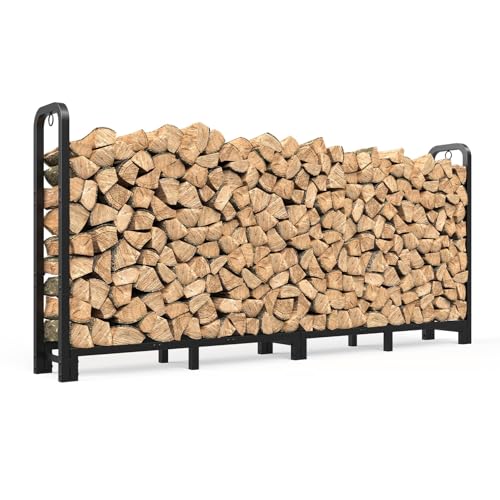
First, verify the frame construction and metal gauge. A single cord of seasoned oak can weigh well over 3,000 pounds, so storage racks must feature heavy-duty tubular steel with solid welded joints. Look for thick steel tubing coated in a durable, weather-resistant powder finish to prevent rust from setting in after the first freeze. Flimsy wire racks or thin sheet metal holders will bend and buckle when fully loaded with split logs.
Second, check the ground clearance height. The base rails of the rack should suspend your lowest tier of logs at least several inches off the patio, gravel, or dirt. This elevation keeps your fuel safe from creeping ground moisture, standing rainwater, and creeping snowdrifts. It also denies burrowing mice a dry pocket between the dirt and the wood.
Third, examine the top cover design. Look for reinforced fabric covers constructed from heavy-duty oxford polyester with waterproof backing. The best covers adjust vertically along the rack frame or feature front zipper flaps, allowing you to access dry logs quickly without untying complex ropes. Ensure the cover shields the top logs from sleet and falling snow while leaving the lower side tiers ventilated to the breeze.

- BWP Score9.6
BWP Score is a ranking system developed by Bestwinterproducts.com. BWP score has no relationship or impact from any manufacturers or sales agent websites. Learn more
- BrandWoodhaven

Essential Cordwood Building: The Complete Step-by-Step Guide (Sustainable Building Essentials
View on Amazon- BWP Score9.6
BWP Score is a ranking system developed by Bestwinterproducts.com. BWP score has no relationship or impact from any manufacturers or sales agent websites. Learn more
- BrandNew Society Publishers

- BWP Score9.6
BWP Score is a ranking system developed by Bestwinterproducts.com. BWP score has no relationship or impact from any manufacturers or sales agent websites. Learn more
- BrandGsskny

- BWP Score9.2
BWP Score is a ranking system developed by Bestwinterproducts.com. BWP score has no relationship or impact from any manufacturers or sales agent websites. Learn more
- BrandVEVOR

- BWP Score9.2
BWP Score is a ranking system developed by Bestwinterproducts.com. BWP score has no relationship or impact from any manufacturers or sales agent websites. Learn more
- BrandN/A

- BWP Score9.0
BWP Score is a ranking system developed by Bestwinterproducts.com. BWP score has no relationship or impact from any manufacturers or sales agent websites. Learn more
- BrandArtibear
- BWP Score9.0
BWP Score is a ranking system developed by Bestwinterproducts.com. BWP score has no relationship or impact from any manufacturers or sales agent websites. Learn more
- BrandMr IRONSTONE

- BWP Score9.0
BWP Score is a ranking system developed by Bestwinterproducts.com. BWP score has no relationship or impact from any manufacturers or sales agent websites. Learn more
- BrandHONEST OUTFITTERS

- BWP Score8.8
BWP Score is a ranking system developed by Bestwinterproducts.com. BWP score has no relationship or impact from any manufacturers or sales agent websites. Learn more
- BrandVIVOHOME

- BWP Score8.6
BWP Score is a ranking system developed by Bestwinterproducts.com. BWP score has no relationship or impact from any manufacturers or sales agent websites. Learn more
- BrandNANANARDOSO

- BWP Score8.6
BWP Score is a ranking system developed by Bestwinterproducts.com. BWP score has no relationship or impact from any manufacturers or sales agent websites. Learn more
- BrandOld Potters
Last update on 2026-10-02 / Affiliate links / Images, Product Titles, and Product Highlights from Amazon Product Advertising API
FAQs
How long does one full cord of wood last in a wood stove?
In the dead of winter, a single full cord of dense hardwood typically lasts four to six weeks if you burn round the clock. If you only burn fires in the evenings and on weekends, that same cord can easily stretch for three to four months. Burning lighter softwoods or running an older, drafty stove will burn through that cord much quicker.
Can I burn softwoods like pine instead of oak to heat my house?
You can burn softwoods safely as long as the wood is completely dry and seasoned. Softwoods contain less heat density than hardwoods, so you will need to reload the firebox more often and stack about forty percent more total volume for the winter. Softwoods make wonderful kindling, but they leave light, fluffy ash rather than long-lasting hot coals for overnight heating.
How much yard space do I need to stack three cords of wood?
Three full cords of wood equal 384 cubic feet of stacked lumber. If you cut your logs to sixteen-inch lengths and stack them four feet high, you need about seventy-two linear feet of single-row fence space. If you stack the wood in three parallel rows spaced one foot apart, you need an outdoor footprint roughly eight feet wide by twenty-four feet long.
What should I do if I run out of seasoned wood in the middle of winter?
Never burn freshly cut green wood, because it creates heavy creosote deposits that risk a chimney flue fire. If your stack runs out in January, look for local suppliers selling kiln-dried hardwood, or buy compressed hardwood heating bricks from local farm supply stores. These manufactured sawdust bricks burn hot and clean, making them a safe alternative until spring arrives.


Best Warm Winter Scarves 2026 For Cozy Comfort

Best Green Ski Goggles 2026 For Clear Vision On Slopes

12 Best Corner Electric Fireplace 2026: My Ultimate Guide To Pick One

Best Battery Powered Snow Blower 2026 For Effortless Snow Clearing

Best Ski Goggles Under 30 Inches For Crisp Vision And Comfort

Best Cooling Scarf 2026 For Instant Relief And Comfort

Fake Snow for Grass: Create a Realistic Winter Lawn Display

Dimplex Prism Wall Mount Fireplace: Sleek Heat With Modern Flame Style





